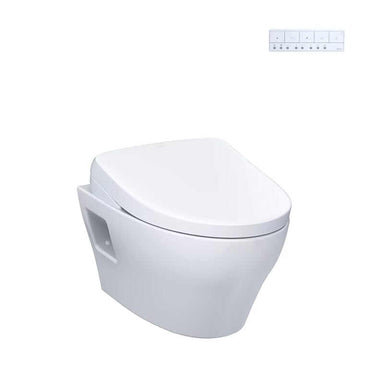
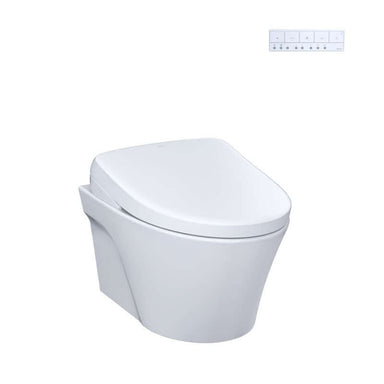
What a Wall-Mounted Smart Toilet Is
A wall-mounted smart toilet is a bowl carried by an in-wall tank system, with warm-water bidet washing, a heated seat, a warm air dryer and automatic flushing in the same fixture. The tank, the supply line and the flush valve all live behind the finished wall, and you flush with a push plate at the wall face.
Every model here is TOTO. The EP and AP are elongated, skirted bowls. The RP is different: TOTO calls it "a new modern D-shape" with a rimless design, and says it "can save you up to nine inches of floor space" against a standard floor-mounted toilet. The EP, AP and RP flush with DYNAMAX TORNADO FLUSH at 1.28 GPF and 0.9 GPF and carry CEFIONTECT glaze, which TOTO says minimizes waste sticking to porous ceramic. The two NEOREST models use TORNADO FLUSH at 1.2 GPF and 0.8 GPF.
The NEOREST models also change how the washing hardware arrives: instead of a WASHLET seat bolted to the bowl, they use a bowl unit plus a top unit with an instantaneous water heater, EWATER+, a warm air dryer with five variable temperature settings, a deodorizer, a night light and four-user memory. On NEOREST, TOTO states that PREMIST wets the bowl's surface, which aids in waste elimination approximately 80% better than a dry bowl. The WX2 adds ACTILIGHT, which TOTO says creates a photocatalytic layer on the bowl surface that helps break down waste.
Do Wall-Mounted Toilets Need a Carrier?
Yes. A wall-mounted toilet needs a carrier, and on these TOTO models the carrier and the tank are one component that bolts into the framing before the drywall goes up. The EP, AP and RP use TOTO's DUOFIT in-wall tank system, a one-piece blow-molded insulated polyethylene tank TOTO says prevents leaks and sweating. The NEOREST WX1 and WX2 use the WT175MA in-wall tank.
Two DUOFIT numbers decide most of the install: it supports up to 880 lbs, and it gives an adjustable 15 to 19 inch mounting height, which is how one bowl can be set to Universal Height or lower. TOTO specifies 2x6 studs for commercial installations and allows 2x4 studs residentially with an optional waste outlet kit, so wall depth is the first thing to check. Compare the lineup in TOTO wall hung toilets.
The Trade-Offs of Going Wall-Hung
The disadvantage of a wall-mounted toilet is that the hard work happens inside the wall, and it happens once. The framing is opened, the tank frame anchored, the drain routed to the carrier outlet and a GFCI outlet run to the toilet before anything closes up. That is why these land in remodels and new construction rather than weekend swaps.
Cost is the second trade-off: you buy a bowl, an in-wall tank system, a push plate and either a WASHLET seat or a NEOREST top unit, plus the labor to modify the wall, which puts these in the luxury bidet toilets tier. The third is service access, since the fill and flush valves sit behind the push plate. In exchange you get a clear floor, a mounting height you chose, and a tank you never look at. If your bathroom cannot take an in-wall tank, a complete bidet toilet on the floor gives you the same washing features.
What to Know Before Buying a Wall-Mounted Smart Toilet
Before buying a wall-mounted smart toilet, settle five things: the depth of your wall, which tank system the bowl requires, where the electrical run goes, which washing package you want, and how much automation you will use. Most of that is fixed at rough-in and hard to change once the drywall is up.
1. Check your wall depth first
The in-wall tank has to fit between the studs. TOTO's DUOFIT system is specified for 2x6 studs in commercial installations, with 2x4 framing allowed residentially when you add the optional waste outlet kit. If you would rather not open the wall at all, the floor-mounted models in smart toilets do the same job.
2. Match the bowl to its tank system
These sell as packages, not as a bowl you pair with any frame. The EP and AP WASHLET+ sets ship with the bowl, the in-wall tank, the WASHLET seat, the push plate and a connection kit. The RP uses the same DUOFIT family; the NEOREST WX1 and WX2 use the WT175MA tank. Order the package, and hand the spec sheet to your plumber before the drain is set.
3. Run the electrical before the wall closes
Every model in this collection is electric. The heated seat, water heater, dryer and sensors all need a GFCI outlet near the toilet, and that run is far easier to add while the studs are exposed. Decide on the fixture first, then let the wiring follow the spec sheet.
4. Choose the washing package
The WASHLET tier is the biggest feature decision. The WASHLET S7A and the WASHLET S7 both pair with the EP and AP, and both give you rear and soft rear cleanse, front cleanse, wide front cleanse, a heated seat, a warm air dryer, a deodorizer, EWATER+, PREMIST and a night light. The S7A is the one that adds an auto open/close lid and auto flush; the S7 uses a manual lid. On the RP, the WASHLET RX covers front and rear washing with adjustable temperature and pressure, a heated seat, PREMIST and a deodorizer; the RW adds an automatic lid and EWATER+.
5. Decide how much automation you want
Automation is where the price climbs. An auto flush model flushes on its own and keeps a back-up manual flush for power outages. An auto open/close lid is on the S7A, the RW and both NEOREST models. EWATER+ auto-cleans the wand, bowl and under-seat after every use, which is the feature that quietly saves the most work. If none of that matters, the RX package covers the wash, the heat and the deodorizer for less.