










How Do You Dry Yourself If You Use a Bidet?
You dry yourself after a bidet wash with the seat's built-in warm-air dryer, by patting dry with toilet paper, or with a small towel kept only for that purpose. Every seat in this collection is built around the first option: you stay seated, press the dry button, and warm air finishes what the water started.
Our guide to drying after using a bidet walks through all three. The dryer suits anyone who wants a hands-free finish, folded paper patted rather than wiped is the fastest, and a reusable towel only works if one person uses it and it gets washed often. Shifting slightly from side to side while the dryer runs moves the airflow around and speeds it up.
What a Warm-Air Dryer Actually Does
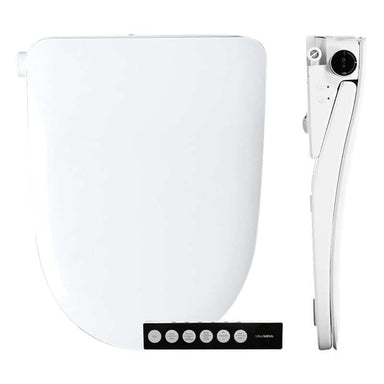
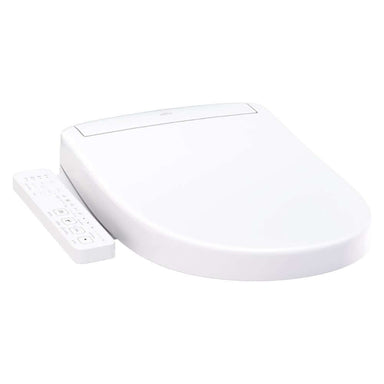
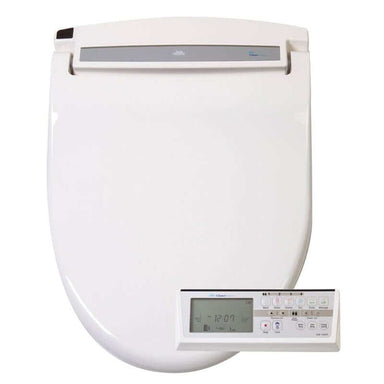
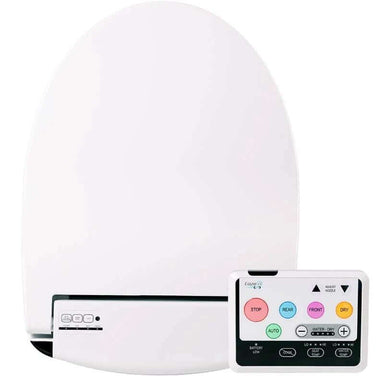
A warm-air dryer is a heating element and a fan built into the back of the seat, aimed at the area the nozzle just washed. TOTO calls it a "temperature-adjustable warm-air dryer," and the adjustable part is what matters day to day. The WASHLET S7A runs five variable dryer temperature settings across a 95°F to 140°F range. The S2 offers three settings across the same range. On the Ultra NOVA the dryer runs a three-minute cycle on low, medium, or high heat, reaching up to 131°F. Brondell's Swash Thinline T44 has five dryer levels and lets you set how long the cycle runs.
Is a Bidet with a Dryer Worth It?
A bidet with a dryer is worth it if you want to stop buying toilet paper and you have an outlet near the toilet. The dryer is the feature that turns a bidet seat from something that reduces paper into something that can replace it. Our guide to what a bidet costs notes that families often cut toilet paper use by 75 percent or more, and that some people who rely on warm-air drying stop buying it altogether.
The hands-free finish is also why these seats come up so often in bidets for seniors and the elderly. Not having to twist and reach makes the routine easier for anyone with limited reach or grip strength.
Two honest limits. A dryer is slower than paper, and a three-minute cycle is a real wait rather than an instant. It also costs more, because it adds a heating element, a fan, and the electronics to run them. If speed matters to you more than going paperless, a seat with warm water and a heated seat but no dryer will cost less. TOTO WASHLET bidet seats include models on both sides of that line.
How to Choose a Bidet with a Dryer
Choosing a bidet with a dryer comes down to five checks: confirm the model actually has one, see how adjustable it is, match the seat to your bowl, find your outlet, and decide how the water gets heated. Get those right and the seat fits and behaves the way you expect on day one.
1. Confirm the seat really has a dryer
Not every electric bidet seat includes a warm-air dryer, and warm water does not automatically mean warm air. TOTO's WASHLET A2 is the clearest example: it has adjustable warm water, adjustable pressure, and a heated seat, but no dryer. Read the feature list on the product page before you order.
2. Look at how adjustable the dryer is
Dryer adjustability is the difference between using the feature every day and ignoring it. Entry-level dryers give you a few heat steps. Higher-end seats give you more steps, and sometimes control over cycle length. The WASHLET S2's three temperature settings and the S7A's five cover the same 95°F to 140°F span; the S7A simply lets you land more precisely inside it.
3. Match the seat to your bowl
Measure from the seat bolts to the front rim. Roughly 16.5 inches means a round bowl; roughly 18.5 inches means elongated. Then check bolt spacing and the flat space behind the bolts, because both vary by brand. The Brondell Swash 1400 fits bolt holes 5.25 to 8 inches apart and wants at least 1.5 inches of tank clearance. The Ultra NOVA needs 4.6 to 7.2 inches and fits elongated bowls only. Shop by shape in elongated bidet seats or round bidet seats.
4. Find your outlet before you buy
A dryer needs power, and power cords are short. TOTO's WASHLET seats run on 120V with a 3.9-foot cord. The Ultra NOVA's cord is 4 feet. Brondell asks for a GFCI outlet within 3.5 feet of the toilet. If nothing is within reach, budget for an electrician alongside the seat rather than planning on an extension cord.
5. Decide how the water is heated
Warm air is only half the experience, because the wash comes first. Tank-style seats hold a small reservoir of pre-heated water and give you about 40 seconds before it cools and has to reheat. Instantaneous heaters, like the one in the WASHLET S7A and the ceramic element in Brondell's Thinline T44, heat on demand and do not run out. For a household with several users, start with bidets with instant and unlimited warm water.
Bidet Seats with Dryers vs. Bidet Toilets with Dryers
There are bidet toilets with heated water and a dryer built in, not just seats. TOTO's NEOREST line integrates both into the fixture, with an "individually adjustable dryer" that "follows the warm water spray to ensure a dry, clean overall feeling." The real difference is what you are replacing.
A bidet seat swaps out the seat on the toilet you already own and keeps the bowl, the flush, and the footprint. It mounts to the bolt holes already in your bowl, and it costs less. A bidet toilet replaces the whole fixture, hides the electronics inside it, and integrates flushing with the wash. If you were going to replace an aging toilet anyway, compare complete bidet toilets before you commit to a seat.