


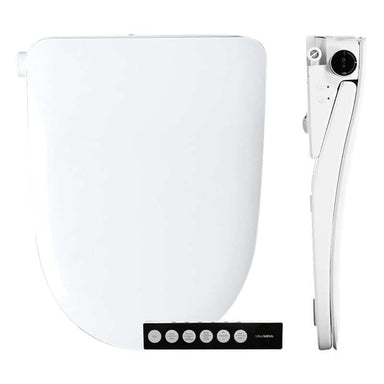


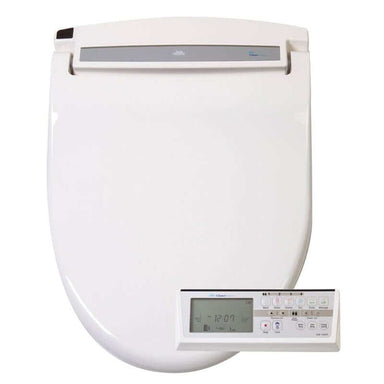


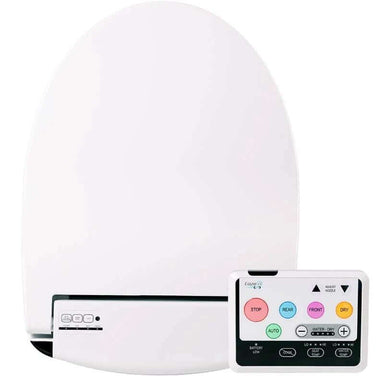


What a Smart Bidet Is
A smart bidet is an electronic bidet seat that washes you with warm water at the press of a button. It draws from the same fresh water line that fills your toilet tank, heats that water inside the seat, and sprays it through a retractable nozzle that rinses itself before and after every use. It never reuses bowl water, and the nozzle never touches you.
Everything in this collection is a seat, not a fixture. Your bowl and your plumbing stay as they are, and the original seat goes back on in minutes if you move. If you would rather have the technology built into the toilet itself, that is a smart toilet or a complete bidet toilet.
The features that define the category
- Front and rear warm-water wash, with adjustable pressure, temperature, and nozzle position
- A heated seat you set by level, and a warm-air dryer
- A self-cleaning nozzle that rinses before and after each use
- Remote or side-panel control, often with saved settings for more than one person
- On higher models: a deodorizer, a night light, an auto open-close lid, and a sittable lid
Smart Bidet vs WASHLET: What Is the Difference?
The difference between a smart bidet and a WASHLET is that "smart bidet" is the category and WASHLET is TOTO's brand name for its own version of it. TOTO describes the WASHLET as "TOTO's award-winning bidet seat, which fits most toilets sold in North America," and introduced it in 1980 as the world's first luxury toilet seat with electronic bidet functionality. Every WASHLET is a smart bidet; not every smart bidet is a WASHLET.
What the name carries is TOTO's own technology list — EWATER+, which electrolyzes water to produce a sterilizing agent that keeps the wand and bowl hygienic; PREMIST, which wets the bowl surface to aid waste removal; and AIR-IN WONDER-WAVE, described by TOTO as "a soothing warm flow of aerated water." Those names appear only on TOTO WASHLET models. Other brands here use their own equivalents.
Pros and Cons of a Smart Bidet
The pros of a smart bidet are a more thorough and gentler clean than dry paper, a sharp drop in toilet paper use, and comfort features you feel every day; the cons are the upfront cost, an electrical requirement, and hardware that is visibly bulkier at the back than a plain seat.
Pros
- Water cleans more thoroughly than wiping, and adjustable pressure sets how firm the wash is.
- Households cut toilet paper use heavily, and a warm-air dryer can make it optional.
- Easier for anyone with limited reach — see bidets for seniors and the elderly.
- It replaces a seat, not a fixture, so it is reversible when you move.
Cons
- They cost more than a standard seat, and more than a non-electric attachment.
- They need a GFCI outlet near the toilet, which not every older bathroom has.
- Repairs can involve electronic parts rather than a washer and a wrench.
- In a power cut, the wash, the heated seat, and the dryer stop until power returns.
How to Choose the Right Smart Bidet
The best smart bidet is the one that fits your bowl, reaches an outlet, and heats water the way your household actually uses it. Those three decisions rule out more models than any feature list does, so work through them first.
1. Match the seat to your bowl shape
Measure from the two seat-bolt holes at the back of the bowl to the front rim. About 16.5 inches means a round bowl; about 18.5 inches means elongated. Several models here are made for one shape only — the TOTO WASHLET S7A is "designed for elongated bowls only" and will not fit a round toilet, and the Ultra NOVA is elongated only. CleanSense, Infinity, Galaxy, and Brondell Swash models come in both. Once you have the number, shop elongated bidet seats or round bidet seats.
2. Decide how the seat heats water
Instant, tankless heating warms water as it flows, so the wash never turns cold — the WASHLET S7A delivers "instant and continuous warm water that never runs out," and the Ultra NOVA and Infinity Eaze Z3 also heat on demand. Hybrid systems, used on the Brondell Swash EM417, the CleanSense 1500, and the Galaxy GB-5000, give steady warm water with no storage tank. If several people use the bathroom back to back, start with bidets with instant and unlimited warm water.
3. Check the outlet and the clearance behind the bowl
Every seat here plugs in. TOTO specifies a ground-fault 120-volt outlet within three feet of the toilet, and the other brands call for a GFCI outlet at the same distance. Measure behind the bowl too, because the control housing sits at the back of the seat. The Brondell Swash Thinline T44, for example, needs mounting holes 5.25 to 8 inches apart and at least two inches of tank clearance.
4. Remote control or side panel
Remotes keep the buttons off the seat and usually store profiles — the WASHLET S7A holds four memory settings for four people, and the Thinline T44 saves two. Side controls cost less and never need a battery; the Swash EM417 uses a side arm, and the CleanSense 1500 comes in both versions. If a remote matters, filter to bidets with remote control.
5. Pick the two or three features you will actually use
Past the wash itself, the features that change daily use are the heated seat, the warm-air dryer, a deodorizer, an auto open-close lid, a night light, and a quick-release seat. Each one adds cost, so choose the ones you would genuinely miss. Browse by feature with bidets with a dryer or bidets with auto open-close lids.
6. Then pick a brand, and read the warranty
Brand mostly decides the technology names and the warranty term. TOTO brings EWATER+ and PREMIST; Brondell's Swash range runs from side-control seats up to slim tankless models; Nova, CleanSense, Galaxy, Infinity, and Blooming fill the middle with instant or hybrid heating. Coverage varies more than the spec sheets do, so check the warranty term before you commit — it is the clearest signal of how long a brand expects its electronics to last.