










Why Most People Buy a Bidet Seat Instead of a Bidet Toilet
A bidet toilet seat delivers nearly everything a full smart toilet does at a fraction of the cost, because you are only replacing the seat — not the fixture, not the supply line, not the floor. That one fact is why bidet seats outsell complete bidet toilets by a wide margin.
You keep the toilet you already own
The bowl stays, the flush stays, the footprint stays. Nothing gets demolished and nothing gets hauled away. If you rent, the original seat goes back on in ten minutes when you move.
Installation is an afternoon, not a plumbing job
Most bidet seats install in 20 to 30 minutes with an adjustable wrench. Shut off the supply valve, remove the old seat, mount the bracket to the same two bolt holes, tee the included T-valve into the fill line, connect the hose, and plug it in. No pipe cutting, no permits, and in the standard case no plumber.
The hygiene difference is real
Warm water cleans more thoroughly than dry paper, and the nozzle never contacts your skin. Most owners keep toilet paper for patting dry and use a small fraction of what they used before. For people managing hemorrhoids, recovering from surgery, dealing with sensitive skin, or living with limited mobility, the value is less about preference and more about managing independently — which is why bidet seats show up so often in aging-in-place bathroom plans.
The price range is wider than most people expect
Non-electric seats typically start under $100. Mid-range electric seats with warm water, a heated seat, and a dryer land in the few-hundred-dollar range. Luxury seats with tankless heating, auto open/close lids, and premium nozzle systems run past $1,000. Shop by budget: budget bidets or luxury bidets.
What a Bidet Toilet Seat Will Not Do
The limits matter more than another list of benefits:
- It will not change your bowl's shape. Round stays round, elongated stays elongated.
- A non-electric seat will never heat the seat, and it only delivers warm water if you plumb it to a hot line.
- A tank-style electric seat will not deliver endless warm water — plan on tankless if back-to-back use is normal in your house.
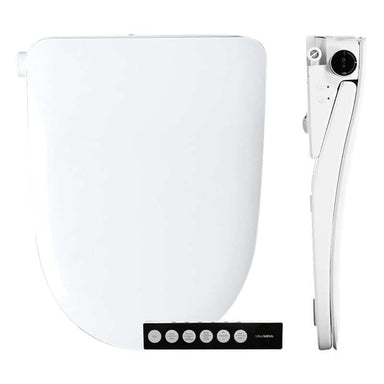
- It will not hide the hardware. Every electric seat is visibly bulkier at the back than a standard seat.
- It will not fit every bowl. Skirted, French-curve, and some designer one-piece toilets need a model confirmed compatible first.
If any of those are dealbreakers, a complete bidet toilet or a smart toilet solves them by replacing the fixture instead of the seat.
How to Choose a Bidet Toilet Seat
Choosing a bidet toilet seat comes down to five decisions: the shape of your toilet, electric versus non-electric, how the seat heats water, where your nearest outlet is, and which comfort features you will actually use. Get those five right and almost any seat in this collection will fit and perform the way you expect.
1. Match the seat to your toilet's shape
Bidet toilet seats come in two shapes: round and elongated. Measure from the two seat-bolt holes at the back of the bowl to the front edge. Roughly 16.5 inches means a round bowl; roughly 18.5 inches means elongated. Ordering the wrong shape is the single most common mistake buyers make, and it takes thirty seconds to avoid. Once you have your measurement, shop elongated bidet seats or round bidet seats.
2. Decide between electric and non-electric
Non-electric bidet seats run on water pressure alone. They cost less, install anywhere, and never need an outlet — but the water arrives at whatever temperature your supply line delivers, and there is no heated seat and no dryer. Electric seats add warm water, a heated seat, adjustable pressure and nozzle position, a warm-air dryer, and usually a remote. If you have an outlet within reach, electric is the version most people are picturing when they imagine a bidet seat.
3. Understand tank versus tankless water heating
Electric seats heat water one of two ways. Tank models store a small reservoir of pre-heated water: they cost less, but the warm water runs out after roughly 30 to 45 seconds and needs time to reheat. Tankless models heat on demand, so the warm wash never runs out — the better choice for households with several users or anyone who prefers a longer wash. See bidets with instant and unlimited warm water.
4. Check your outlet and your clearance
An electric seat needs a grounded outlet within about three to four feet of the toilet, and GFCI protection is standard in bathrooms. Check the space behind the bowl too — the control box sits at the back of the seat, so an overhanging tank lid or a very tight alcove can interfere. For genuinely tight spaces, start with bidets for small bathrooms.
5. Choose the features you will actually use
Beyond the wash itself, the features that change daily use are the heated seat, the warm-air dryer, an oscillating or pulsing nozzle, a deodorizer, a nightlight, and an auto open/close lid. Each one adds cost. Decide which two or three you would genuinely miss and ignore the rest. Browse by feature: bidets with a dryer, heated bidets, bidets with remote control, bidets with deodorizers.