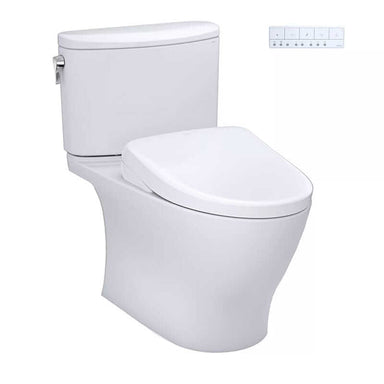
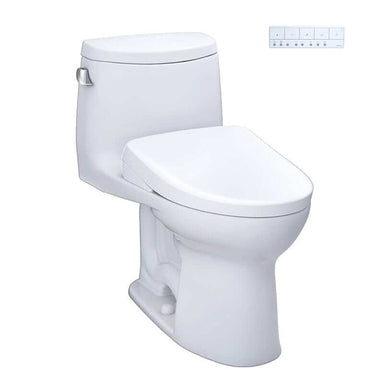
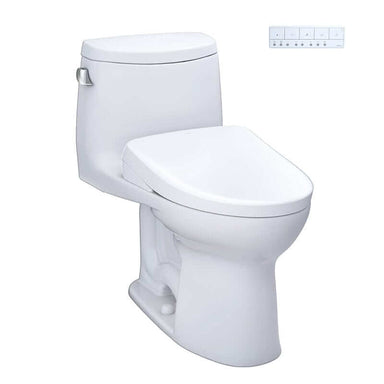
Is 1.28 GPF Good for a Toilet?
1.28 GPF is good for a toilet, and it is the volume most new toilets are now built around. GPF means gallons per flush. Federal law has capped US toilets at 1.6 gallons since 1994, and WaterSense, the EPA's efficiency program, requires 1.28 gallons or less. TOTO's 1.28 models carry that certification: the product listings state that they meet EPA specifications for water efficiency and performance.
That certification decides where you are allowed to install a toilet, not just how much water it uses. Several states have adopted 1.28 GPF as the legal maximum for new toilet installations, including California, Texas, Colorado and Georgia, with others following. In those states a 1.6 GPF toilet is not a legitimate choice for a new install, whatever your preference. Rules change, so check your local requirements before ordering, but 1.28 is the safe default anywhere in the country.
What 1.28 gallons actually saves
For a family of four, a 1.28 GPF toilet uses about 9,000 gallons a year against about 11,500 gallons for a 1.6 model, a difference of around 2,500 gallons. At most municipal rates that is a modest saving in any single year. It matters because a toilet lasts fifteen to twenty-five years, so the saving repeats for the whole life of the fixture. Our 1.28 vs 1.6 GPF guide sets the two side by side.
Which Is Better, 1.28 or 1.6?
1.28 is the better choice for almost every new installation, and on a modern TOTO you give up nothing to get it. The belief that 1.6 flushes better comes from the first generation of low-flow toilets in the 1990s, which genuinely did clog because they were simply restricted. TOTO's current flushing systems, TORNADO FLUSH, DYNAMAX TORNADO FLUSH and G-Max, were engineered around the lower volume instead.
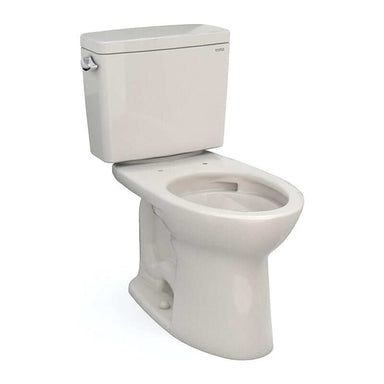
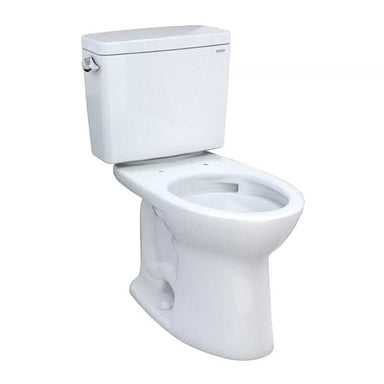
The Drake shows what that means in practice. The 1.28 and 1.6 versions use the same bowl and the same flush engineering, and the 1.28 is the more recently updated design. TOTO's own listing for the 1.28 GPF elongated Drake pairs TORNADO FLUSH, described as two nozzles creating a centrifugal, cyclonic rinsing action, with the CEFIONTECT ceramic glaze that helps keep the bowl cleaner longer. Where flush performance genuinely varies is between series, not between flush volumes within a series.
Three cases still argue for 1.6: you live in a state that permits it and the model you want is only made in 1.6; your home has old, shallow-slope drain lines and a plumber has specifically recommended more water per flush; or you are matching an existing toilet in a two-toilet bathroom. Outside those, there is little reason to choose it. Going the other way, several TOTO ranges offer a 1.0 GPF version. Those perform well, but talk to us first if your drain run is long or shallow, because very low volumes leave less margin in older plumbing.
How to Choose a 1.28 GPF Toilet
Once the flush volume is settled, choosing a 1.28 GPF toilet comes down to four things: your rough-in, the bowl shape, the seat height, and whether you want a one-piece or a two-piece. Every toilet in this collection is a TOTO at 1.28 gallons, so these are the decisions that change what actually arrives at your door.
Measure your rough-in before anything else
Rough-in is the distance from the finished wall to the center of the closet bolts that hold the toilet down. Twelve inches is the common size, but 10-inch and 14-inch bathrooms exist, so measure yours rather than assume. Measure to the finished wall and not the baseboard, and use the back pair of bolts if your toilet has four.
Which alternatives you get depends on the series. Most TOTO skirted ranges, including the Aquia IV, Aimes, Legato, Carlyle II, Vespin II, Soiree and Guinevere, use the Unifit adapter, which is ordered with the toilet and fitted during installation. The Drake works differently: TOTO makes a separate 10-inch model rather than an adapter, and it fits a 10-inch drain only. The Nexus is 12-inch and 14-inch only, with no 10-inch version at all. Our rough-in size guide lists every series we stock, and there is a dedicated 14 inch rough-in collection if that is your measurement.
Bowl shape and seat height are separate decisions
Measure from the seat bolts to the front edge of the ceramic: about 16.5 inches is a round bowl, about 18.5 inches is elongated. Elongated is more supportive and gives you the widest choice of models and bidet seats; round saves those two inches in a powder room or tight alcove. Height is the other axis. TOTO's Universal Height puts the seat about 17 to 19 inches off the floor against about 15 inches for standard height, and TOTO marks it with an F in the model number. Browse tall toilets if standing up from a low seat is the problem you are solving.
Is It Better to Buy a One-Piece or Two-Piece Toilet?
Neither is better across the board: a one-piece toilet is easier to clean around and reads as more modern, while a two-piece is easier to handle during installation and comes in more configurations and price points. A one-piece fuses the tank and bowl into a single seamless unit. A two-piece ships as a separate tank and bowl that are joined on site.
The practical differences are few joints against easier repairs. A one-piece has fewer seams to clean and fewer connections to maintain, but it arrives as one heavy object. A two-piece lets you replace an individual component later and is far simpler for one person to carry up a flight of stairs. Both are available at 1.28 gallons throughout this collection. Compare one-piece toilets against two-piece toilets, or read the longer one piece vs two piece breakdown.
Decide about a WASHLET now, not later
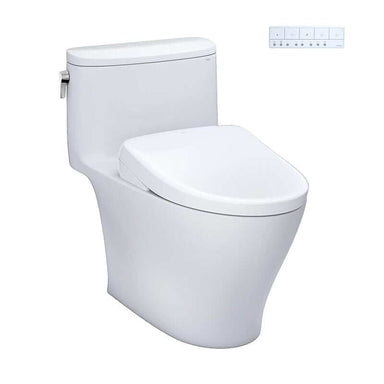
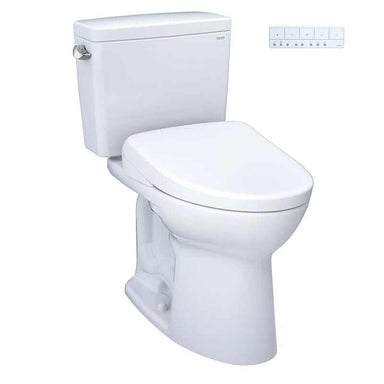
Many of the toilets in this collection are sold as complete WASHLET+ sets, where the bidet seat's water supply and power cord are hidden inside the fixture instead of running down the back. The UltraMax II one-piece at 1.28 GPF, for example, is built specifically to accommodate WASHLET+. If a bidet seat is even a maybe, choosing a WASHLET+ ready model now costs nothing extra later. See the WASHLET+ sets.